
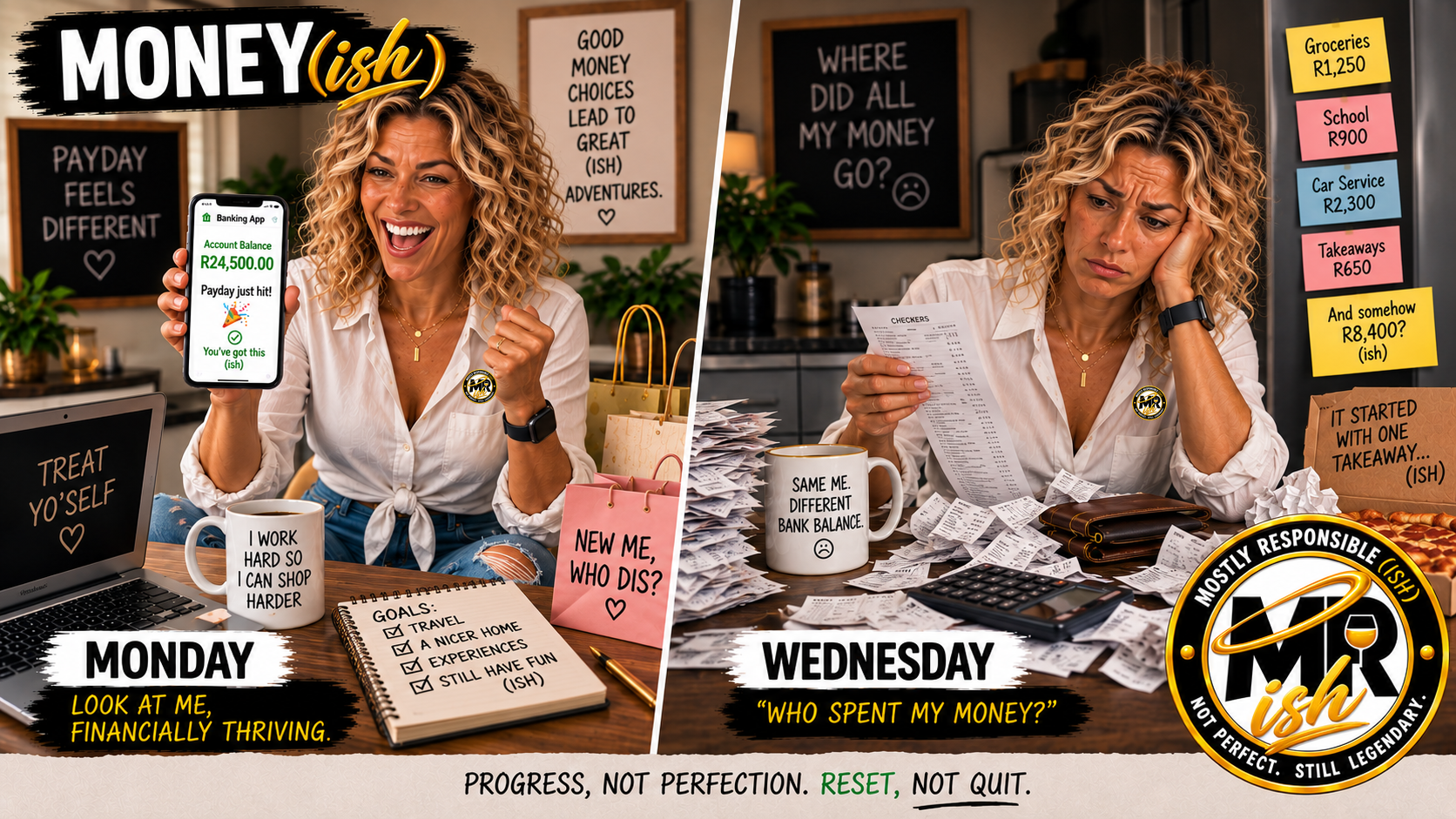
Payday is magnificent.
For roughly seven minutes, you’re absolutely loaded.
Not retire tomorrow loaded, obviously. But definitely add cheese without asking what it costs loaded.
You worked your arse off for this money. Meetings. Deadlines. Traffic. People who somehow reply-all to emails specifically saying please don’t reply-all.
So when that salary lands, there is a brief and beautiful moment when you look at your bank balance and think:
Finally. A number that respects me.
Take a screenshot.
Frame it.
Show the children what their inheritance looked like before they got involved.
Because sooner or later, you’re going to open that banking app again, stare at the number, refresh it just in case your bank missed a zero somewhere and discover:
Nope. Still disrespectful.
And that’s usually when the interrogation begins.
Where did it go? What did I buy? Why are there seventeen transactions I don’t remember?
Who authorised all this?
Unfortunately, the suspect has access to your PIN.
And this is where things get interesting, because asking “Where did my money go?” immediately makes it sound like something went wrong.
Like your salary packed a tiny suitcase, climbed out the bathroom window and started a new life in Durban.
But hang on.
Look at what the bloody stuff did.
It kept a roof over your head. Fed people. Kept the lights on. Moved the car. Paid for school things, insurance, data, Wi-Fi and the approximately 48 other things apparently required to participate in modern civilisation.
Your money didn’t just disappear.
The poor bastard reported for duty.
Some of it had important jobs. Some bought things you genuinely wanted. And some of it…
You genuinely have no idea.
Those are the sneaky little buggers.
R80 here. R120 there. Another R60 somewhere else. Nothing dramatic enough to set off an alarm.
It’s only R100.
Possibly the most expensive cheap sentence you’ll say all month.
One R100 isn’t going to destroy the empire.
The problem is apparently you said it seventeen times.
Get enough of those innocent little transactions together and suddenly they’ve formed a small criminal organisation.
And that’s why maybe “Where did my money go?” isn’t quite the question we need.
What did my money do?
Now you have to look.
Some of it kept your life running. Good. Some bought things you chose and enjoyed. Also good.
Some might reveal that the numbers genuinely don’t work. There simply isn’t enough coming in to comfortably cover everything going out. Cancelling one coffee isn’t going to magically fix maths.
And then there’s the money that makes you stare at the transaction for ten seconds thinking:
What on earth was I thinking?
That’s useful too.
Because there’s a difference between money you deliberately spent and money you barely noticed leaving.
That’s where responsibility sneaks into the room.
Not guilt. Not punishment. Not sitting at the kitchen table with seventeen spreadsheets while somebody explains why you’re never allowed cheese again.
Just knowing what your money actually did.
Because you can’t make a different decision about money you don’t even remember spending.
So sometime after payday, open your banking app and scroll through a few days.
No spreadsheet. No calculator. No dramatic announcement that the family is entering A NEW FINANCIAL ERA.
Just look.
What paid for your life?
What did you genuinely enjoy?
And what makes you squint at the screen like you’re reviewing evidence for the prosecution?
What did my money do?
Maybe you’ll discover you’re doing far better with your money than you give yourself credit for.
Maybe you’ll find one thing quietly costing far more than you realised.
Maybe you’ll discover that “it’s only R100” has been running a side hustle behind your back.
Whatever you find, now you’ve seen it.
And next time that innocent little R100 appears, you don’t need somebody sitting on your shoulder giving you a lecture about responsible spending.
You’ll remember what happened to the other seventeen.
That’s the sneaky little advantage of paying attention.
You don’t have to stop enjoying your money, become a budgeting monk or stop adding the bloody cheese.
You just start making a few more purchases on purpose, instead of discovering them afterwards.
Your money can still have fun. It just shouldn’t be having more fun than you are.
And if you discover a small criminal organisation operating inside your bank account, come tell us what got you.
No screenshots required.
We’re Mostly Responsible(ish). Not SARS.
Mostly takeaway:
Payday isn’t a financial position. It’s a brief emotional experience. The trick is figuring out what keeps ending it so bloody quickly.

JOIN THE CHAOS…